English
 Français



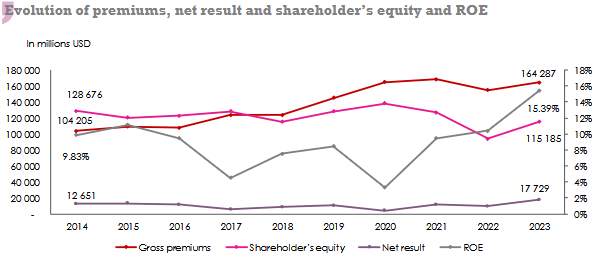
Europe remains the world's leading reinsurance market, with a market share of 43.4% in 2023 (excluding Lloyd's of London). This share is down 6.9 points compared with 2014.
The European reinsurance market: main indicators 2014-2023
Figures in millions USD
| 2014 | 2018 | 2022 | 2023 | 2014-2023 evolution (1) | |
| Gross premiums | 104 205 | 123 721 | 155 194 | 164 287 | 5.20% |
| Share capital | 14 959 | 15 844 | 15 861 | 15 973 | 0.70% |
| Shareholder’s equity | 128 676 | 115 583 | 93 959 | 115 185 | -1.20% |
| Net result | 12 651 | 8 693 | 9 785 | 17 729 | 3.80% |
| ROE | 9.83% | 7.52% | 10.41% | 15.39% | 5.10% |
| Loss ratio (2) | 61.70% | 68.10% | 69.70% | - | |
| Combined ratio IFRS 4 (3) | 92.40% | 100.70% | 98.90% | - | |
| Combined ratio IFRS 17 (2) | - | - | 90.80% | 87% |
(1) Exchange rate in local currency
(2) AM Best, ratios of the main non-life reinsurers under IFRS 4
(3) Source : AM Best, ratios of the main non-life reinsurers under IFRS 17 (Munich Re, Hannover Re and SCOR)
To discover | Atlas Reinsurance Reports - Europe 2026
The European reinsurance market in 2023
Like other markets and regions, the European reinsurance market is up against a number of economic, climatic, technological and geopolitical challenges.
Although reinsurers operate in a dynamic environment that is less regulated than that of insurers, they are still subject to an increasingly complex and restrictive regulatory framework.
Concentration of the European reinsurance market
The four leading European players, excluding Lloyd's, namely Munich Re, Swiss Re, Hannover Re and SCOR occupy a dominant position at both continental and global level.
These reinsurers account for a combined turnover of 131.348 billion USD in 2023, representing 79.9% of European underwriting and 34.7% of worldwide underwriting.
Figures in millions USD
| 2014 | 2018 | 2022 | 2023 | 2014-2023 evolution (1) | |
| Europe | 104 205 | 123 721 | 155 194 | 164 287 | 5.20% |
| Top 4 (2) | 90 657 | 106 353 | 125 488 | 131 348 | 4.20% |
| World | 207 294 | 268 060 | 363 477 | 378 543 | 6.90% |
| Top 4 in % of global premium | 43.70% | 39.70% | 34.50% | 34.70% | - |
| Top 4 in % of European premium | 87.00% | 85.96% | 80.86% | 79.95% | - |
| Europe's share of the global premium | 50.30% | 46.20% | 42.70% | 43.40% | - |
(1) Average annual growth rate
(2) Top 4: Munich Re, Swiss Re, Hannover Re and SCOR
Consolidation of the European reinsurance market
The European reinsurance market, excluding Great Britain, has witnessed significant consolidation in recent decades, with various mergers and acquisitions giving rise to world-scale groups.
While this consolidation has reduced the number of competitors, it has also led to better risk management.
The European reinsurance market: predominantly non-life
 The market is mainly made up of reinsurers operating in the non-life sector.
Eight out of 26 reinsurers offer exclusively non-life products; the rest underwrite both life and non-life business. There are no life-only reinsurers in Europe.
Non-life business accounted for 69% of European underwriting in 2023.
International presence of European reinsurance
European reinsurers have a strong international presence. The business icons Munich Re, Swiss Re, Hannover Re and SCOR have geographically fragmented portfolios, with subsidiaries and offices underwriting risks in the four corners of the globe.
This leverage enables these reinsurers not only to offer better underwriting conditions and lower rates to their ceding companies, but also to impose their norms and standards on the entire global market.
Diversification and appetite for specialty and innovation risks
Even if the industry's watchwords in 2023 were about discipline and refocusing, European reinsurers are still on the lookout for new opportunities.
To better diversify their activities, the major reinsurers are ready to develop their portfolios in specialty lines such as cyber risks, marine transport and engineering.
These companies are also best equipped to cover new risks such as artificial intelligence, energy transition and parametric reinsurance.
The European reinsurance market facing rising claims
 In the past, Europe had been considered to be less exposed to natural hazards than the United States or Asia, but in recent years it has seen a sharp rise in its natural catastrophe claims.
In 2023 and 2024, extreme weather conditions led to severe storms and flooding.
In 2023 alone, the European continent sustained 109 billion USD in economic losses due to natural catastrophes, 27 billion USD of which were borne by insurers and reinsurers.
The unstable economic and geopolitical situation, for its part, has led to an increase in the costs associated with riots and social unrest. The tensions caused by the Russia-Ukraine war and events in the Middle East are also affecting the business climate and reinsurance.
Lastly, the emergence of new technologies and, by extension, cyber risk, is increasing the exposure of European reinsurers to natural and man-made catastrophes.
The European reinsurance market: stricter regulations
Regulatory tightening is also increasing pressure on the European reinsurance market. This is the case with Solvency II, which sets out the capital and risk management requirements for insurers and reinsurers.
Other European directives, such as the 2022 Corporate Sustainability Reporting Directive (CSRD) and the 2023 Retail Investment Strategy Directive (RISD), apply to both insurers and reinsurers in the region.
Environmental, social and governance (ESG) standards are also gathering momentum, and are now used as risk assessment criteria.
Reinsurers are therefore required to respond to all these new pressures and expectations. They are being asked to become more involved in environmentally-friendly projects, which could increase their costs and lead to additional constraints.